
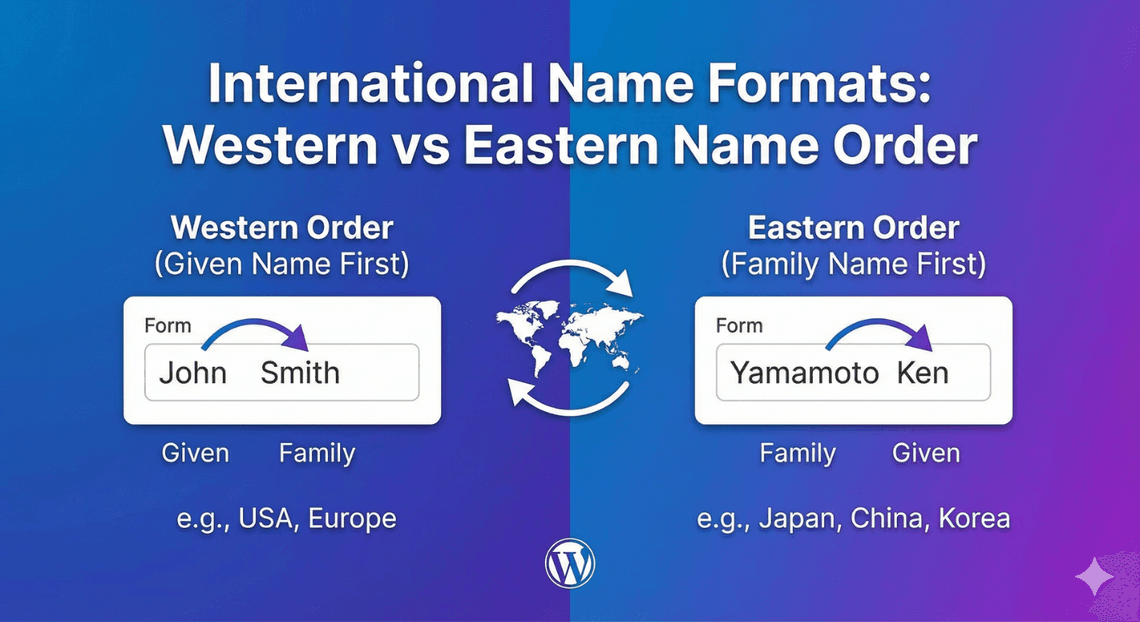
International Name Formats: Western vs Eastern Name Order
The humble “First Name / Last Name” form is quietly built on an assumption: that everyone’s name has exactly two parts in that order. For a large part of the world, that’s not true. In many East Asian cultures the family name comes first; some people have one name, others have many; and name order and structure vary widely. If you collect names from a global audience, a little thoughtfulness makes your forms work for everyone. Here’s how to handle international names with Auto Form Builder’s Name field.
Why “first and last” isn’t universal
Western naming convention puts the given name first and the family name last — Sarah Mitchell. But Eastern conventions, common across much of East Asia, put the family name first — so the order many of your visitors naturally use is reversed from what a Western-style form expects. On top of that, some people go by a single name, others have multiple given or family names, and honorifics and suffixes vary. A form that rigidly enforces “first name then last name” can force people to enter their name incorrectly just to get through it.
Option 1: a single full-name field
The simplest, most universally respectful approach is often a single full-name field. One box labeled “Full name” lets people enter their name exactly as they write it — in whatever order and structure is correct for them — with no assumptions imposed. For many forms, especially where you just need to know who someone is, this is the cleanest choice. It’s one of the two approaches covered in our guide to collecting names.
Option 2: separate parts, clearly labeled
When you do need structured data — to personalize emails or sort contacts — the Name field supports separate parts (First, Middle, Last, and Suffix), which you can lay out to suit your form. The key is to label them clearly and consider your audience. “Given name” and “Family name” are more universally understood than “First” and “Last,” and they sidestep the order assumption because they describe the role of each part rather than its position.
Be flexible about required parts
Rigid required rules cause the most friction for international names. If you enforce a middle name or a specific structure, you’ll block people whose names don’t fit. Keep required parts to the genuine minimum, and let the rest be optional. Someone with a single name, or a different structure than you expected, should still be able to complete your form without fighting it.
Personalize carefully
Once you’re collecting names respectfully, use them respectfully too. If you personalize emails, a full-name greeting is safer than assuming which part is the “first” name to use casually — getting that wrong can feel worse than not personalizing at all. Where you’ve captured separate parts, you can use conditional logic and your notification settings thoughtfully, but when in doubt, a respectful full-name greeting rarely offends.
Respectful forms for a global audience
- Prefer a single full-name field when you don’t strictly need structured parts.
- If you split the name, label parts as “given” and “family” and keep the order assumption-free.
- Require only what you truly need, so unusual name structures aren’t blocked.
- Personalize with care, favoring the full name when unsure.
Handling names well is a small thing that signals real respect to a global audience — and it often means a shorter, more flexible form too. It’s all built into the free Name field.
Ready to build forms that work for everyone? Install Auto Form Builder free from WordPress.org.
FAQ
How should I collect names from a global audience?
Offer flexibility. A single full-name field or clearly-labeled separate parts both work; avoid assuming everyone has exactly one first and one last name in Western order.
Does the Name field support different name structures?
Yes. You can use one full-name field, or separate parts (first, middle, last, suffix) laid out to suit your form, so it fits a range of naming conventions.